Chur and its history
get to know the oldest city in Switzerland through pictures
All photos have been taken and edited by yours truly, enjoy!
See the city more or less through the eyes of an exchange student, spending one semester in Chur

About Chur
Nestled between mountains and rivers, Chur is Switzerland’s oldest city — a place where history and everyday life blend seamlessly. Its narrow streets, colorful facades, and hidden corners tell stories of centuries past, while modern rhythms fill the air.

Chur roots stretch back over 5,000 years. Once a Roman settlement known as Curia Rhaetorum, it grew into an important regional center in the Alps. Over the centuries, Chur has balanced tradition and transformation — from medieval trade routes to modern urban life — while preserving its distinctive old town, winding alleys and vibrant cultural spirit.
Bündner Kunstmuseum
The roots of the museum go back to 1900, when the Graubünden Art Association was founded with the goal of promoting art in the region and building a public collection.


Between 2014 and 2016, the museum underwent a major expansion. A new contemporary building by the Barcelona-based architects Barozzi and Veiga was added, creating a striking contrast between the historic villa and a minimalist modern structure.

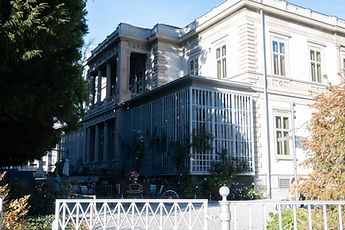
In 1919, the association established a museum in the Villa Planta, a grand neoclassical villa built between 1874 and 1875 by architect Johannes Ludwig.

The Kunstmuseum Chur functions as the central institution for visual arts in Graubünden.It presents a permanent exhibition from its collection and hosts five to six temporary exhibitions each year, featuring historical and contemporary art, photography, graphics, and new media.The museum is also an active cultural hub, offering educational programs, workshops, guided tours, and events for visitors of all ages.

The Rätisches Museum in Chur is the historical museum of the canton of Graubünden, housed in a baroque patrician building dating from 1675.
Inside, its permanent collection spans four floors and shows archaeological finds, cultural-historical and folkloric objects from across Graubünden. From prehistoric times through the Middle Ages, Renaissance and Baroque periods up to the 19th and early 20th centuries
Other museums in Chur are for example the Rhaetian Museum which presents the history of Graubünden from the beginning to this day.
And The Cathedral Treasure Museum.
The the The Cathedral Treasure Museum displays over a thousand years of sacred art from the bishopric.
Visitors can see beautifully crafted reliquaries, gold and silver liturgical vessels, medieval textiles, and rare illuminated manuscripts.
Its most famous highlight is the 1543 “Dance of Death” cycle, a series of vivid paintings showing medieval views on life and mortality.

The Cathedral Treasure Museum.


Cathedral of the Assumption of Mary

Reformierte Martinskirche/St. Martin’s Church

The churches in Chur
The most prominent church is the Cathedral of St. Mary of the Assumption, a Romanesque-Gothic landmark whose foundations date back over a thousand years and which dominates the old town from its hilltop beside the bishop’s court.
In the city center stands St. Martin’s Church, recognizable by its tall spire and colorful stained-glass windows by the artist Augusto Giacometti.
Nearby, smaller churches such as St. Regula and St. Luzi show how monastic traditions and local legends are woven into Chur’s identity.
Together, these churches form an architectural timeline of the city, illustrating its role as an early religious center of the Alps and a crossroads between different cultures and eras.

St. Luzi


St. Regula
Chur Theater

Theater Chur is the largest theatre in the canton of Graubünden.
Special mentions
The building that houses Theater Chur was originally constructed between 1861 and 1863 as a military arsenal by the architect Johannes Ludwig. Its style—with rounded arches and a historicist reference to medieval-Italian architecture.
In 1959, the building was converted (by architect Martin Risch) into a dual-purpose facility: the city’s theatre and the cantonal parliament building.
Konvikt Chur is a residence for students of the Bündner Kantonsschule (BKS), especially those from distant valleys of the canton and for exchange students like me.
The building was designed after an architectural competition in 1963 — the winning design came from architects Otto Glaus and Ruedi Lienhard (with collaboration from Sep Marti). Construction took place between 1967 and 1969. The Konvikt was inaugurated and put into operation around 1968.
Konvikt
Architecturally, it is a distinctive example of the post-war modernist / “Brutalist” style — a terraced concrete construction built into the hillside, to adapt to the steep terrain above Chur.

Some more photos from Chur


